Services
Retaining walls in Hobart
Most Hobart blocks slope. A retaining wall is what turns that slope into ground you can actually use, and it is the part of a yard you cannot fix cheaply later. I build walls in dry stone, block, sandstone and timber, along with the steps and terraces that go with them.
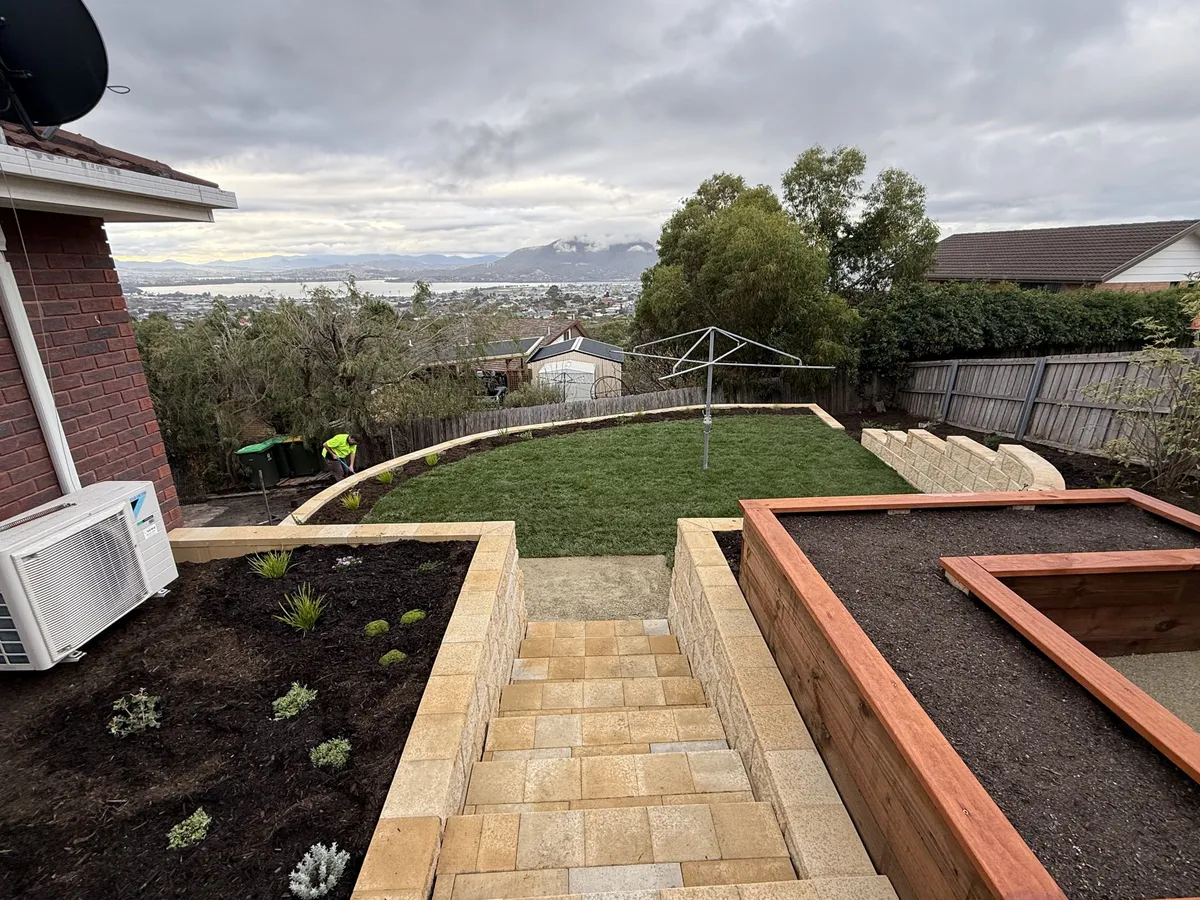
Retaining walls are the backbone of most landscape transformations, and a lifetime around stone and timber pays off here. From hand-stacked stone walls to engineered block retaining, everything gets the right base, drainage and fixings, because a wall should be as sound behind the face as it looks from the front.
Dry-stone walls
Stacked by hand, no mortar, each stone chosen and placed so the wall carries its own weight and drains through itself. It is slow work and it shows. A dry-stone wall settles into a garden the way a mortared wall never does, and it keeps looking better as the moss and the planting catch up with it. Best for garden walls, terrace fronts and lower retaining where the look matters as much as the job it does.
Block retaining walls
Where a wall has real load to carry, block is what I reach for. Core-filled and reinforced, on a footing sized for the height, with agricultural drain and free-draining backfill behind it. Blockwork does not have to look like a car park. Capped, rendered or paired with a cable balustrade above it, a block wall reads as a deliberate part of the garden.
Sandstone walls, beds and edging
Sandstone is the Hobart material. It suits the older suburbs, it warms up in the afternoon light, and it cuts and stacks into raised beds, low walls and edging that tie a whole yard together. I use it a lot for terracing where the retaining job is modest and the finish is doing most of the work.
Timber walls
Treated pine or hardwood sleepers, on properly set posts, with drainage behind. Timber is the cheapest way to hold back a bank and the fastest to build, and it is the one material with a clock on it. I will be honest with you about how long a timber wall will last on your site before you spend the money.
Steps, terraces and levels
Steps are where most sloped yards are won or lost. A yard with a good set of steps gets used. A yard with a steep track worn into the grass does not.
I build steps in stone, sandstone, block and timber, set out so the rise and the going stay consistent the whole way up, because uneven steps are the ones people trip on. Where a slope is too steep to be one flight, it becomes terraces with landings between them, and the landings turn into the flat spots a yard needs anyway: a place for the shed, a lawn the kids can use, a spot that catches the morning sun.
Terracing is also the honest answer to a block that has been unusable since the house was built. Cut and fill across two or three levels and a bank nobody could walk on becomes a garden.
What goes in behind the wall
The face of a wall is the part you pay for and the part you never see is the part that decides whether it is still standing in twenty years.
Every wall I build gets a compacted base sized for what sits on it, free-draining backfill, and a drain at the bottom that goes somewhere. Water is what kills retaining walls. It builds up behind the face, the pressure has nowhere to go, and the wall starts to lean. Give the water a path out and the wall stops fighting.
On Hobart blocks that matters more than most places. Clay soils hold water, a lot of the city sits on slopes that move, and a wall that would be fine on flat sandy ground is not fine here.
Working on Hobart slopes
Access is the other thing that decides a Hobart job. Steep driveways, narrow side gates and neighbours close on both sides change what machinery can get in, and that changes the price and the method. I would rather work that out standing in your yard than guess at it from a photo, which is why every job gets a site visit before there is a fixed price.
Decks and paving are built as part of a wider transformation, where they tie into the walls, levels and planting around them. For stand-alone deck or paving jobs I can point you to trusted local specialists.
Recent work
Retaining walls I've built around Hobart
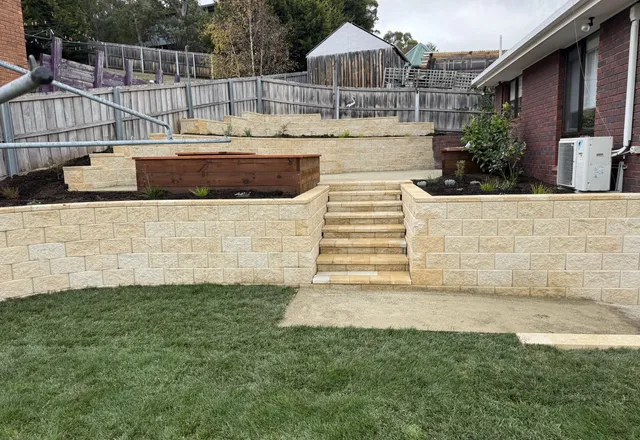
Terraced Backyard Transformation, Before & After
Greater Hobart, TAS
A steep, overgrown backyard rebuilt as curved sandstone terraces, raised beds and fresh turf, photographed from the first dig to the final planting.
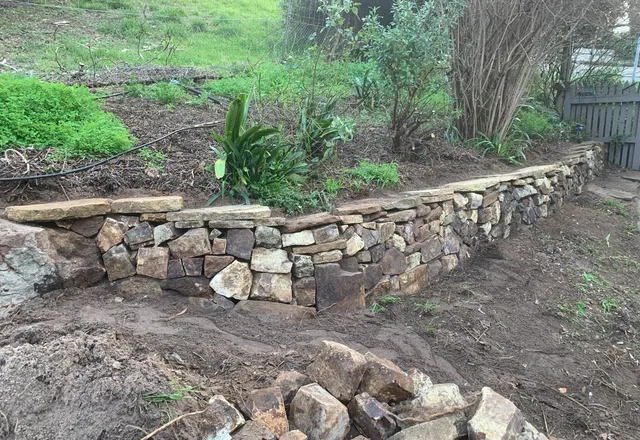
Dry-Stone Walls & Garden Edging
Southern Tasmania
Hand-laid dry-stacked stone walls, built with the craft Robin learned on Tasmania's famous walking tracks.
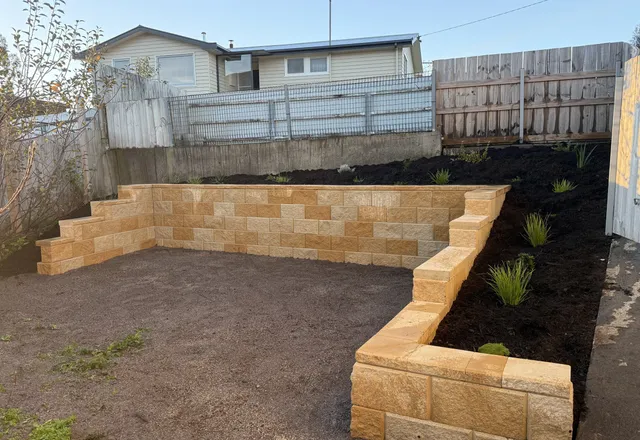
Eroding Bank to Sandstone Walls, Before & After
Greater Hobart, TAS
A bare backyard with a crumbling, washed-out bank rebuilt with sandstone-block retaining walls, a planted slope and a levelled yard ready for lawn.
Questions
Retaining walls: common questions
How much does a retaining wall cost in Hobart?
It depends on height, length, material and how hard the site is to get machinery into. A low sandstone garden wall and an engineered block wall holding back a driveway are different jobs at different prices. Send me photos and rough measurements and I will give you a free estimate, then a fixed price quote after I have walked the site.
Do I need council approval for a retaining wall in Tasmania?
It depends on the height of the wall and what it is holding back. In Tasmania lower walls on stable ground, clear of boundaries and easements, are often treated as low-risk work. Once a wall gets taller, carries a load like a driveway, sits in an easement, or the block falls in a landslide hazard area, it needs engineering and paperwork with the council. Plenty of Hobart is in a landslide hazard band, so this comes up more here than it does on the mainland. I will tell you which side of the line your job sits on before we start, and I work in with the building surveyor or engineer when one is needed.
Which material should I use?
Dry stone suits gardens and lower walls and ages better than anything else. Block is the workhorse for anything structural, and it can be rendered or capped so it does not look industrial. Sandstone is the Hobart look and works well for beds, edging and steps. Treated timber is the cheapest per metre and the shortest lived. I will tell you what I would use on your site and why.
How long should a retaining wall last?
A wall built on a proper base with drainage behind it should outlast you. Walls fail because water gets trapped behind them and has nowhere to go, or because the base was never right. Both are decisions made on day one, and both are invisible once the wall is finished.
Can you build steps and paths at the same time?
Yes, and it is usually cheaper to do it together. The machinery is already on site, the levels are being set anyway, and steps that were designed with the wall look better than steps added afterwards.
Do you take on retaining wall work on its own?
My main work is full landscape transformations, where the wall is one part of a bigger plan for the yard. I do take on wall-only jobs when they are the right size. Get in touch and I will tell you straight away if it suits.
Where I work
Retaining walls across greater Hobart, on both sides of the Derwent and out to Sorell. Not sure if I come to you?Get in touch. Travel is rarely a problem for the right job.
Other services
Ready to get started?
Free estimates across greater Hobart. Call, text or send through a few photos of your yard.